Have questions about
the new ITIL?
Explore detailed FAQs covering what’s changed, what stays the same, and how learning and certification work in ITIL (Version 5).
What’s changing in ITIL?
Getting started with new ITIL
Understanding the Official Qualification Scheme
Exams, learning options, and certification information
Moving to new ITIL: your transition options

What’s changing in ITIL?

What’s changing in ITIL?

What is new in ITIL?

ITIL (Version 5) introduces major evolutions that make the framework more practical, flexible, and relevant for everyone working with digital products and services, across roles, teams, and organizations of all sizes.

Key innovations include:

Modern, Integrated and Comprehensive Approach
ITIL (Version 5) provides guidance that works across the entire organization - from leadership and strategy through to day-to-day operations - helping teams collaborate, align priorities, and consistently create value in both stable and fast-changing environments.

AI-Native and Complexity-Ready
ITIL (Version 5) helps professionals work effectively in complex, AI-enabled environments by providing practical guidance on how to adapt, make informed decisions, and manage change as technology, business needs, and customer expectations evolve.

Integration of Products and Services
ITIL provides end-to-end lifecycle guidance for digital products and services, integrating both for holistic management and value.

Emphasis on Digital Experience
Digital experience is a core focus in ITIL (Version 5), helping professionals design, deliver, and improve digital products and services with greater visibility, collaboration, and understanding of how different stakeholders experience value.

Continuity with Previous Versions
ITIL (Version 5) incorporates proven concepts and models from ITIL 4 and earlier, including the value system and guiding principles.

Why did ITIL evolve? Why now?

A new version is needed because the digital landscape has changed dramatically. Organizations today must operate faster, smarter, and more flexibly, especially with AI transforming how work gets done.

The new ITIL arrives now to address these realities:

Digital-first, product-centric enterprises require updated guidance.
Previous versions focused mainly on services; modern organizations manage integrated products and services.

AI and automation are reshaping operations.
The new ITIL provides an AI-native approach that helps organizations adapt and innovate confidently.

Businesses need models that support agility and rapid change.
The new ITIL evolves to ensure adaptive, outcome-focused practices aligned with real-world needs.

Organizations must continually demonstrate measurable value.
The new framework strengthens the link between people, practices, and technology to drive sustainable business results.

In short: the new ITIL evolves to match today’s AI-driven, fast-changing environment, providing practical guidance that supports people across all roles and organizations in delivering and improving digital products and services.

What is the rationale for going back to “version” prior to the number? ITIL v3 > ITIL 4 > ITIL (Version 5)?

We use ITIL (Version 5) in training and certification contexts to clearly signal the evolution of the ITIL framework. Each new version represents a meaningful step forward, building on proven guidance while adapting to how digital products, services, and organizations operate today. This reinforces that ITIL evolves with the profession, rather than being replaced or reset.

Who is ITIL (Version 5) aimed at overall (beyond Foundation)?

Beyond Foundation, ITIL (Version 5) is aimed at professionals who are involved in designing, delivering, managing, and improving digital products and services, and who want to apply ITIL guidance in real-world, complex environments.

It is designed for practitioners working across:

- Product and service management
- IT and digital delivery
- Experience, operations, and improvement
- Strategy, transformation, and leadership roles

ITIL (Version 5) extends beyond traditional IT roles to support teams across the business, recognizing that value creation today happens through collaboration between technology, product, service, and experience-focused functions. It is relevant for professionals at different career stages, from hands-on practitioners to those leading change and transformation initiatives, and for organizations of all sizes operating in digital and AI-enabled environments.

Getting started with new ITIL

Getting started with new ITIL

What is ITIL Foundation (Version 5) and who is it for?

ITIL Foundation (Version 5) provides the building blocks of ITIL (Version 5) and is the first step in the ITIL learning journey.
It is designed as an introduction to ITIL, enabling candidates to view digital product and service management through a complete lifecycle model for the creation, delivery, and continual improvement of digital-enabled products and services in the AI era.

ITIL Foundation (Version 5) is suitable for organizations and professionals who are starting their ITIL journey and looking to create value with digital products and services.

Can I take the ITIL Transformation module after ITIL Foundation?

Yes. There is no prescribed order for taking ITIL (Version 5) modules. After completing ITIL Foundation, you may take ITIL Transformation if it aligns with your role, interests, or career goals.

Understanding the Official Qualification Scheme

Understanding the Official Qualification Scheme

What certifications are available in ITIL (Version 5)?

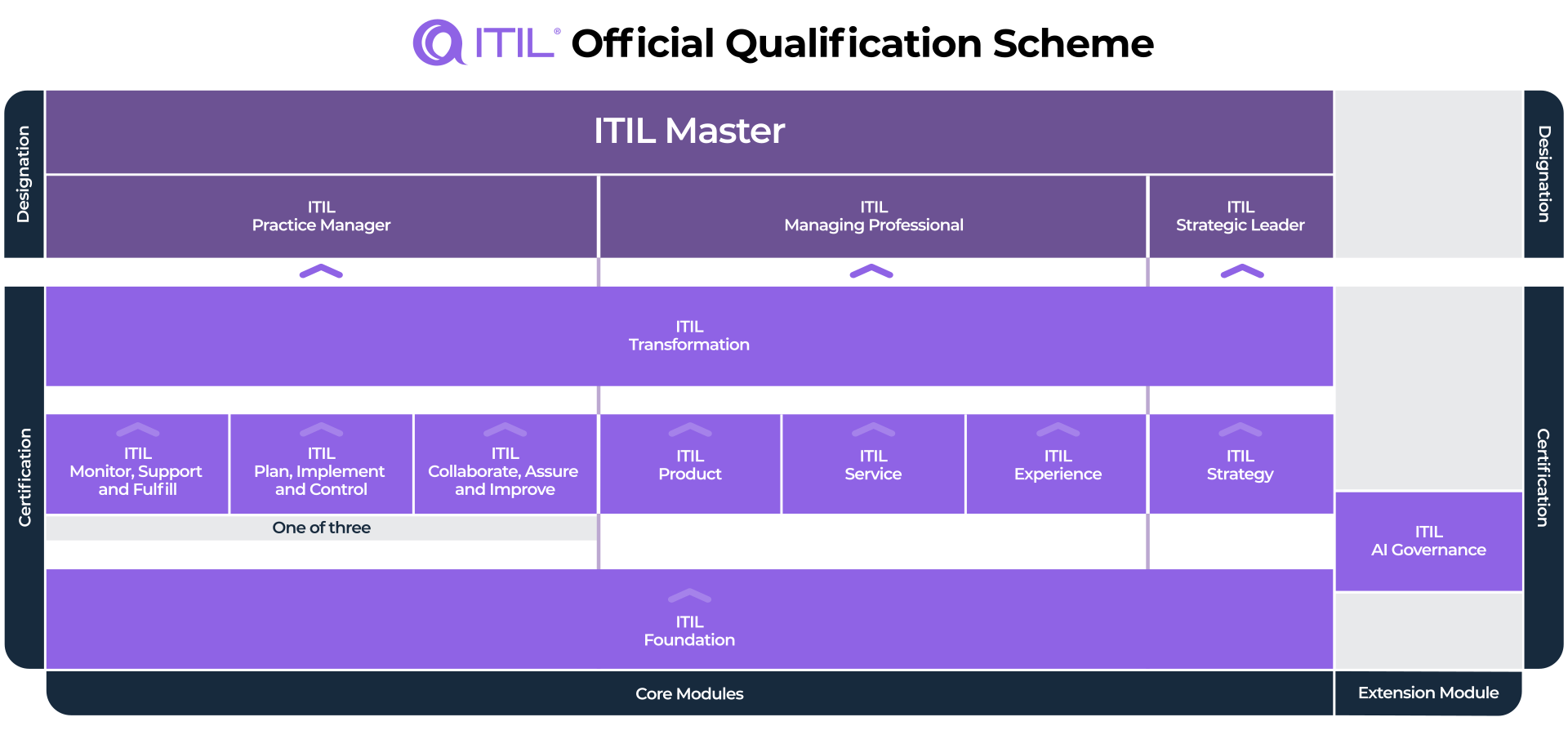
In ITIL (Version 5), the qualification scheme begins with the ITIL Foundation and continues with eight upper-level modules and one extension module. 

The ITIL (Version 5) qualification scheme diagram below provides a visual overview of how the certifications and designations fit together and how candidates can progress through the framework. 

new-itil-qualification-scheme-1920x800-borderless


The upper-level modules are organized into three distinct streams: 

1. ITIL Practice Manager (ITIL PM) 
2. ITIL Managing Professional (ITIL MP) 
3. ITIL Strategic Leader (ITIL SL) 

Successfully completing the defined modules within a stream grants the respective designation. 

Achieving all three designations leads to the highest recognition: the ITIL Master. In total, ITIL (Version 5) offers four designations, each building toward holistic mastery of Product and Service Management. 

To become an ITIL Practice Manager (ITIL PM), candidates complete ITIL Foundation and then choose one of the following specialization modules, each including a set of practices: 

- Monitor, Support and Fulfil (MSF): Service Desk, Incident Management, Problem Management, Service Request Management, Monitoring & Event Management 

- Plan, Implement and Control (PIC): Change Enablement, Deployment Management, Release Management, Service Configuration Management, IT Asset Management 

- Collaborate, Assure and Improve (CAI): Relationship Management, Supplier Management, Service Level Management, Continual Improvement, Information Security Management 

To obtain the ITIL Practice Manager (Version 5) designation, candidates must also complete the ITIL Transformation course and pass the corresponding exam. 

The ITIL Managing Professional (ITIL MP) designation requires ITIL Foundation plus the modules: Product, Service, Experience, and Transformation. 

The ITIL Strategic Leader (ITIL SL) designation requires ITIL Foundation plus the modules: Strategy and Transformation. 

ITIL Transformation is a core component of every designation within ITIL (Version 5). It only needs to be completed once, and the achievement counts across all designations. 

AI Governance is introduced as an extension module, reflecting the importance of managing AI responsibly within service management. 

The ITIL Master designation recognizes deep expertise and the proven ability to adopt ITIL in complex, real-world contexts.


Are there any extension modules in ITIL (Version 5)?

AI Governance is the only extension module in the ITIL (Version 5) qualification scheme. It focuses on establishing frameworks, policies, and controls to ensure AI is used responsibly, ethically, and in alignment with organizational and regulatory standards. 

The ITIL 4 extension modules are no longer part of the ITIL (Version 5) qualification scheme, as their content has been absorbed into the broader ITIL guidance and future learning offerings, reflecting how the framework has evolved.

ITIL Transformation (Version 5) is a universal module. What does this mean, and will I have to take it twice?

ITIL Transformation (Version 5) is a core module forming part of the ITIL Practice Manager, ITIL Managing Professional, and ITIL Strategic Leader designations. It only needs to be taken once.

Do I have to pass all Practice Manager modules and the Transformation modules to receive the ITIL (Version 5) Practice Manager designation?

No, you only have to pass one of the Practice Manager modules (free choice of one) and the Transformation module to automatically receive the ITIL (Version 5) Practice Manager designation.

Are the single day Practice courses included in the ITIL (Version 5) qualification scheme?

No, only the three bundled Practice modules are available in the ITIL (Version 5) qualification scheme.

Exams, learning options, and certification information

Exams, learning options, and certification information

Is ITIL (Version 5) training mandatory for candidates or can they self-study?

PeopleCert has not mandated training for ITIL Foundation (Version 5), so you are able to self-study. However, candidates you are encouraged to attend an accredited training course or take official eLearning courses, which will become available over time, to fully understand the new material.

For all other modules, in line with ITIL 4 requirements, accredited training or official eLearning is required.

What do the examinations look like within the ITIL (Version 5) qualification scheme?

The ITIL Foundation (Version 5) certification will remain a closed-book, multiple-choice examination. ITIL AI Governance will also be assessed through a closed-book examination.

For the ITIL Product, Service, Experience, Strategy, and Transformation certifications, open-book examinations are planned. This approach is intended to support a stronger focus on understanding, applying concepts, and making informed decisions, rather than memorization.

For the three Practice Manager bundled modules (Version 5), the examination format is also being finalized, with open-book examinations currently planned. Final details will be confirmed in line with the launch of each module.

How are the ITIL Practices accessed and where are they published?

All 34 ITIL (Version 5) practices are available exclusively via PeopleCert Plus membership. In addition, the 15 practices that are part of the Practice Manager modules are available as accompanying training materials together with the corresponding training courses.

In which languages will ITIL (Version 5) be available, and what is the localization schedule?

ITIL (Version 5) will initially be available in English. Additional languages are planned, and we are working to accelerate the localization process while maintaining a high standard of quality. Localization release schedules will be confirmed and shared as they are finalized.

Will ITIL (Version 5) certificates require renewal?

Yes. ITIL (Version 5) certificates will be issued with a three-year renewal date.

If you hold ITIL 4 certifications, these will also be renewed by taking and passing any ITIL (Version 5) certification, as all ITIL certificates sit within the same product suite.

The renewal routes for ITIL (Version 5) remain consistent with ITIL 4, as well as with our PRINCE2 and DevOps Institute DEVOPS INSTITUTE portfolios.

The available renewal options are:

- Become a PeopleCert Plus member and participate in the Continuous Professional Development (CPD) programme by logging 20 CPD points per year for three consecutive years, based on everyday professional activities.

- Take another certification from the same product suite. For ITIL (Version 5), the product suite includes all ITIL certifications.

- Retake the same certification.

Moving to new ITIL: your transition options

Moving to new ITIL: your transition options

I have an ITIL 4 Foundation certification. How should I transition to ITIL (Version 5)?

If you hold an ITIL 4 Foundation certification, you do not need to re-take Foundation in order to progress to upper-level ITIL (Version 5) modules. ITIL (Version 5) represents an evolution rather than a revolution, and ITIL 4 qualifications are fully recognized as prerequisites for all upper-level ITIL (Version 5) certifications.

If you would like a quick and straightforward way to update your knowledge, you may choose to take the ITIL Foundation (Version 5) Bridge. This one-day course focuses on the key changes introduced at Foundation level and includes a short exam. Successful candidates are will be awarded the ITIL Foundation (Version 5) certificate.

I have a single ITIL 4 certificate, but no ITIL 4 designation. What is the best way to continue my ITIL journey?

With any ITIL 4 certificate, you already have a strong starting point for progressing into ITIL (Version 5). ITIL 4 certificates are recognized as valid prerequisites for ITIL (Version 5) upper-level certifications.

The best way to continue your journey is to choose an ITIL (Version 5) path that aligns with your career goals and role aspirations. Your ITIL 4 experience is not lost, it provides valuable context that will make learning ITIL (Version 5) easier and help you connect established best practices with the latest guidance in digital product and service management.

I am one certificate away from the ITIL 4 Managing Professional designation. What is the best way to continue my ITIL journey?

This is excellent progress in your ITIL journey. If you are close to achieving the ITIL 4 Managing Professional designation, the recommended path is to complete your final ITIL 4 module and achieve the designation.

Once you have achieved ITIL 4 Managing Professional, you can then take the ITIL Managing Professional (Version 5) Transition module, which enables you to transition your designation to ITIL (Version 5).

This approach allows you to complete what you have already started, recognize the progress you have made, and move smoothly into the new ITIL qualification scheme. ITIL 4 and ITIL (Version 5) will run in parallel for a period to support a smooth transition for professionals and organizations.

I have the ITIL 4 Managing Professional designation. How should I go about transitioning to ITIL (Version 5)?

Holders of the ITIL 4 Managing Professional designation can move directly into the ITIL Managing Professional (Version 5) Transition module.

This transition module is designed to introduce the core foundational concepts of ITIL (Version 5) and then build on them with key guidance from the ITIL Experience, ITIL Product, ITIL Service, and ITIL Transformation areas. It enables experienced professionals to carry their existing knowledge forward while gaining a clear understanding of how ITIL has evolved.

The ITIL Managing Professional (Version 5) Transition module is in the final stages of validation. Further details will be shared once confirmed.

I have the ITIL 4 Strategic Leader designation. How should I go about transitioning to ITIL (Version 5)?

Holders of the ITIL 4 Strategic Leader designation can upgrade their designation by completing the ITIL Transformation (Version 5) module.

ITIL Transformation (Version 5) is a core module required across designations and also upgrades the ITIL 4 Practice Manager designation to ITIL Practice Manager (Version 5).

If you also hold the ITIL 4 Managing Professional designation and complete the ITIL Managing Professional (Version 5) Transition module, your Strategic Leader designation will be automatically upgraded. This is because the Managing Professional Transition module includes the key ITIL Transformation content required for the upgrade.

I have the ITIL 4 Practice Manager designation. How should I go about transitioning to ITIL Practice Manager (Version 5)?

Holders of the ITIL 4 Practice Manager designation can upgrade to ITIL Practice Manager (Version 5) by completing the ITIL Transformation (Version 5) module.

ITIL Transformation (Version 5) is a core module required across designations and also upgrades the ITIL 4 Strategic Leader designation to ITIL Strategic Leader (Version 5).

If you also hold the ITIL 4 Managing Professional designation and complete the ITIL Managing Professional (Version 5) Transition module, your Practice Manager designation will be automatically upgraded. This is because the Managing Professional Transition module includes the key ITIL Transformation content required for the upgrade.

I have the ITIL 4 Master designation. How should I go about transitioning to ITIL (Version 5)?

Holders of the ITIL 4 Master designation can move directly into the ITIL Managing Professional (Version 5) Transition module to upgrade their designations.

This transition module introduces the core foundational concepts of ITIL (Version 5) and then builds on them with key guidance from the ITIL Experience, ITIL Product, ITIL Service, and ITIL Transformation areas. It allows highly experienced professionals to carry their existing knowledge forward while gaining a clear understanding of how ITIL has evolved.

Completion of the ITIL Managing Professional (Version 5) Transition module will also upgrade existing ITIL 4 Managing Professional, ITIL 4 Practice Manager, and ITIL 4 Strategic Leader designations.

The ITIL Managing Professional (Version 5) Transition module is in the final stages of validation. Further details will be shared once confirmed.

I have an ITIL v3 Foundation certification. How should I go about transitioning to ITIL (Version 5)?

The ITIL v3 Foundation certification is not accepted as a prerequisite for ITIL (Version 5) upper-level certifications.

For those who hold ITIL v3 Foundation, the recommended path is to complete ITIL (Version 5) Foundation training and successfully pass the examination. Compared with ITIL v3, ITIL (Version 5) Foundation introduces a significant amount of new and updated content, reflecting how digital products, services, and organizations operate today.

Completing the ITIL (Version 5) Foundation ensures a strong, up-to-date understanding of the latest concepts and prepares professionals to confidently apply ITIL guidance in modern, fast-changing environments.

I have ITIL v3 Intermediate certification(s). What is my route into ITIL (Version 5)?

ITIL v3 Intermediate certifications (such as Service Strategy) are not accepted as prerequisites for ITIL (Version 5) upper-level certifications..

If you have completed one or more ITIL v3 Intermediate certifications, the recommended starting point is ITIL Foundation (Version 5). Compared with ITIL v3, ITIL Foundation (Version 5) introduces a significant amount of new and updated content, reflecting how digital products, services, and organizations operate today..

Completing ITIL Foundation (Version 5) provides a strong, up-to-date foundation and ensures you are well prepared to adopt and apply ITIL (Version 5) effectively in modern, fast-changing business environments.

I have the ITIL v3 Expert designation. How should I go about transitioning to ITIL (Version 5)?

Holders of the ITIL v3 Expert designation can move directly into the ITIL Managing Professional Transition (Version 5) module.

This transition module is designed to introduce the core foundational concepts of ITIL (Version 5) and then build on them with key guidance from the ITIL Experience, ITIL Product, ITIL Service, and ITIL Transformation areas. It allows experienced ITIL professionals to carry their existing knowledge forward while gaining a clear understanding of how ITIL has evolved to support modern, digital, and AI-enabled organizations.

I have the ITIL v3 Master designation. How should I go about transitioning to ITIL (Version 5)?

Holders of the ITIL v3 Master designation can move directly into the ITIL Managing Professional Transition (Version 5) module.

This transition module is designed to introduce the core foundational concepts of ITIL (Version 5) and then build on them with key guidance from the Experience, Product, Service, and Transformation areas. It enables experienced ITIL professionals to carry their existing expertise forward while gaining a clear understanding of how ITIL has evolved to support modern, digital, and AI-enabled organizations.

When will the ITIL (Version 5) Managing Professional Transition module be sunset?

There are currently no plans to sunset or limit the availability of the ITIL Managing Professional (Version 5) Transition module. Learners can continue to use this transition route as part of their ITIL (Version 5) journey.